RAILING WELDING
Metal Railing Welding and Repair
A loose or rusted railing is a fall waiting to happen, and on a commercial property it is also a liability. Alpha Mobile Welding TX coordinates partner welders across Texas who repair and fabricate handrails, guardrails, balcony rails, stair rails and pool guards on site. Rusted base plates, posts wobbling in concrete, cracked picket welds and bent sections are everyday work. Send photos of the damage and the full run. We match the job to a nearby partner and confirm a visit, subject to availability.
Block off a failed railing until it is repaired. Scheduling is subject to partner availability.
Railing basics
What railing welding and repair covers on homes and commercial properties
Railings fall into a few groups that inspectors and welders treat differently. A handrail is the part you grip on a stair or ramp. A guardrail, or guard, is the barrier that stops someone falling from a balcony, landing, deck, mezzanine or retaining wall. Stair rails usually do both jobs at once. Pool fences, balcony guards and ADA-style handrails on commercial ramps carry their own dimension rules on top of the basic ones.
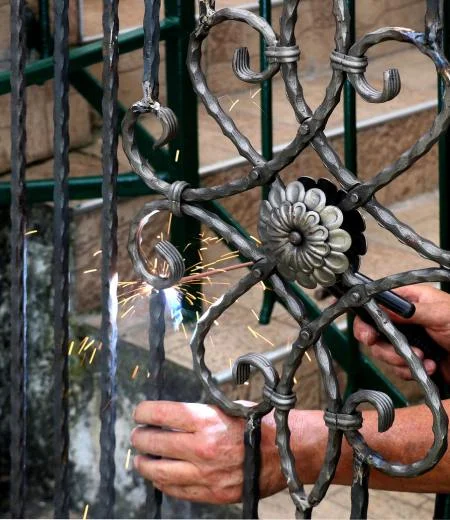
Most Texas railings are steel: square tube posts, flat bar or round pickets, channel or pipe top rails, welded to base plates that bolt into concrete or sleeve into cored holes. Aluminum railings are common on coastal and multifamily properties because they do not rust, and stainless shows up on modern homes and restaurants. Cable infill and glass panels sit in steel or aluminum frames and depend on the posts being rigid.
Repair work is mostly about the connection points. Welds at pickets crack from years of leaning and thermal movement. Base plates trap water and rust from the underside where nobody looks. Posts set in concrete rust at the surface line and snap. Fabrication work is building a new run or a replacement section to match the existing style, then finishing it so it lasts in the weather.
- Handrails, guardrails, stair rails and balcony guards
- Deck, porch, ramp and pool railings
- Steel, aluminum, stainless and cable infill
- Rusted bases, loose posts and cracked welds repaired on site
- New sections fabricated to match existing work
Common failures
Where railings fail and what the repair looks like
Look at the bottom of the posts first. That is where most railings go wrong.
Rusted base plates and anchors
Water pools on the plate, rust lifts it off the concrete and the anchors corrode or pull. Repair is a new plate welded on, fresh anchors in sound concrete and a sealed edge.
Loose posts in concrete
Posts grouted into cored holes rust at the surface and rock in the hole. The post is cut above the damage, a new section sleeved and welded in, and the hole re-set with epoxy or non-shrink grout.
Cracked picket welds
Thin pickets welded to the rail crack from leaning, kids climbing and expansion. Cracked welds are ground out and re-welded; badly rusted pickets are cut out and replaced.
Bent or impacted sections
Vehicle strikes, moving furniture and fallen limbs bend rails and posts. Minor bends are heated and straightened; kinked tube is cut out and a new section spliced in.
Corroded stair rails
Exterior stair rails rust at tread brackets and wherever paint failed. Repairs often come with the stringer work on our exterior metal stairs page.
Wobbly balcony guards
Guards fastened through stucco or siding into weak framing loosen over time. The fix may be a welded plate, blocking behind the wall or a post dropped to a solid slab.
What we do
Railing welding, repair and fabrication services
Partner welders handle both the quick structural fix and the full replacement run.
Steel handrail repair
Cracked joints, rusted bases, loose wall brackets and broken returns on residential and commercial handrails, welded and primed on site.
Guardrail and balcony rail repair
Post replacement, sleeving, re-anchoring and picket replacement on balconies, landings, decks and mezzanines, with temporary bracing while the work is done.
New railing fabrication
Steel, aluminum or stainless rails built to your opening, stair pitch and the dimensions your inspector will check. Larger runs are built through our fabrication partners and installed on site.
ADA-style and commercial handrails
Continuous, graspable handrails with returns and extensions for ramps and public stairs on offices, clinics, churches and apartment complexes.
Stainless and cable rail
Stainless posts, top rails and cable infill tensioned to spec, with TIG welding and passivation detailed on our stainless page.
Pool and deck guards
Pool barrier fences and gates, deck and porch rails on wood or concrete, repaired or replaced to the height and spacing your local code requires.
Why Alpha Welding
Why property owners and managers call Alpha for railings
A safety repair needs someone equipped and code-aware.
Code-aware partners
Welders who know the height, spacing and grip rules inspectors check, and who will tell you when an engineer or permit is needed.
On-site repair
Most repairs are done where the rail stands, with no demolition and no shop transport of a 20-foot run.
Matching fabrication
New sections built to match picket pattern, rail profile and finish so a repair does not look like a patch.
Statewide reach
Partners across Houston, DFW, Austin, San Antonio and more, with coverage confirmed per address.
How it works
How a railing repair is scheduled and done
Four steps from photos to a solid rail.
Send photos
The damage, the base of the posts, the whole run and the surface it mounts to, plus a rough length.
Scope and quote
A partner reviews, we quote repair or replacement and flag any code or engineering questions, then confirm a window.
Repair on site
Failed sections cut out, new steel fitted, welded, anchors set and the rail checked for rigidity.
Finish and hand-off
Welds cleaned and primed, or the rail prepared for galvanizing or powder coat, with notes on inspection if required.
Technical guide
What customers should know about railing codes, repairs and finishes
Railings are the one welding job where dimensions matter as much as the weld. Here is what partners work to and why.
What an inspector checks
Codes vary by city and by occupancy, so verify locally, but the items an inspector measures are consistent. Guard height is typically a minimum of 36 inches on residential balconies and decks and 42 inches on commercial and multifamily properties. Openings in the guard must reject a 4-inch sphere, which sets picket spacing at under 4 inches clear. Handrails on stairs sit roughly 34 to 38 inches above the tread nosing and must be graspable, usually a round or shaped profile about 1-1/4 to 2 inches across, continuous for the full flight. Guards are designed for a concentrated load of around 200 pounds applied at the top in any direction. Pool barriers and ADA ramps add their own rules.
Rusted bases: cut it out, do not patch it
A base plate that has lifted or a post that is paper-thin at the concrete line cannot be fixed with a weld over the rust. The partner cuts the post above sound metal, welds on a new stub with a fresh plate or a sleeve inside the existing tube, and re-anchors. On solid concrete that means wedge or sleeve anchors or, better, threaded rod set in epoxy. Where the old core hole is cracked, the slab is core-drilled nearby and the post grouted with non-shrink grout. A bead of sealant around the plate keeps water out of the joint that started the problem.
Sleeving and splicing sections
Where a rail or post is bent or rotted in the middle, the damaged length is cut out and a new piece spliced in. On square or round tube, an internal sleeve a size smaller is slid in to bridge the joint, then the outer tube is welded around and ground flush so the repair is invisible under paint. Pickets are replaced individually, with welds at top and bottom rails matched to the originals. Partners use MIG with gas where sheltered and flux-core on open balconies, and TIG on stainless and aluminum.
Materials for new railings
Mild steel is the most economical and the easiest to repair later, but it must be galvanized or coated well to survive outdoors. Aluminum needs no coating against rust, weighs a third as much and suits coastal and second-floor work, but it is welded with TIG or a spool gun and is harder to repair in place. Stainless, usually 304 or 316 for coastal sites, is the premium option for modern homes and restaurants and is TIG welded then passivated. Cable infill in a steel or aluminum frame gives an open look but needs stiff posts and proper tensioning so it still rejects the 4-inch sphere.
Finishing so it lasts
Hot-dip galvanizing is the longest-lived finish for steel rails but requires the rail to go to a galvanizer, so it suits new fabrication rather than in-place repair. Powder coating is tough and uniform and also needs a shop. For on-site repairs, partners grind the welds, apply a zinc-rich primer or cold galvanizing compound and a compatible topcoat. On an existing galvanized or powder-coated rail, any area burned by welding must be re-coated or it rusts first.
Safety until the repair is done
- Rope off or barricade a loose guardrail immediately
- Keep children away from balconies with failed pickets
- Do not lean on a post that rocks at the base
- Photograph the damage for insurance or the property file
- Tell tenants and staff before the welder arrives
Related welding services
Not sure if it is repair or replace?
Send photos of the posts at the base and the full run. We will tell you honestly whether a repair will hold or the rail has reached the end of its life.
Service area
Where our railing partners work
Railing repair is common mobile work, so partners are available across most Texas metros and suburbs. Coverage and scheduling are confirmed per address, and new fabrication runs may be built by a shop partner nearest you. See every area on the Texas locations page.
Greater Houston
Dallas–Fort Worth
Central Texas
South & West Texas
FAQs
Railing welding and repair questions
Straight answers on code, repair methods and what can be done on site.
How high does a railing have to be?
Typically 36 inches minimum for residential guards and 42 inches for commercial and multifamily. Stair handrails sit about 34 to 38 inches above the nosings. Local amendments vary, so confirm with your city before building new.
Can a rusted railing post be repaired instead of replaced?
Often yes. If the rail above the base is sound, the post is cut above the rust, a new stub or sleeve welded in and the base re-anchored. If several posts are gone or the rail is pitted through, replacement is usually cheaper.
Do I need a permit for railing repair?
Like-for-like repair usually does not. New railings, height changes and anything on a commercial or multifamily property may require a permit and inspection. We flag that during the quote so you can check with your building department.
Can you match my existing railing style?
Yes for most picket, tube and bar designs. Partners measure the picket pattern, spacing and rail profile and fabricate the new section to match. Ornamental castings and scrolls may be sourced or approximated, which we explain first.
How do you fix a post that wobbles in concrete?
The post is removed or cut, the hole cleaned or re-cored, and the new post set in epoxy anchoring compound or non-shrink grout. Surface-mounted posts get a new base plate and fresh anchors into sound concrete, with sealant around the plate.
Can you weld aluminum or stainless railings on site?
Yes, with TIG-equipped partners. Aluminum and stainless need shelter from wind, clean joints and the right filler. Visible joints are blended and stainless is passivated after welding to restore its corrosion resistance.
What is the 4-inch sphere rule?
Openings in a guard, between pickets or under the bottom rail, must be small enough that a 4-inch ball cannot pass through. It keeps small children from slipping through. New pickets and infill are spaced to meet it, and we check it on repairs too.
How long does a railing repair take?
A single post or a few cracked welds is usually a few hours on site. Multiple posts, re-coring and new sections can run a full day. New fabricated runs take a few days in the shop before installation.
Will the repaired area rust again?
Not if it is finished properly. Welds are ground, primed with zinc-rich primer or cold galvanizing and top-coated, and base plates are sealed. For new rails, galvanizing or powder coating before installation is the better investment.
Can you come out quickly for a dangerous railing?
Often, subject to partner availability. Tell us it is a safety issue, block the area off and send photos. Partners can sometimes brace a rail the same day and return for the full repair. Call 979-250-7486.
Request an estimate
Make that railing safe again
Send photos of the damage and the full run and we will match a railing partner near you. Call 979-250-7486 or request an estimate online.
- Free, no-obligation estimates
- Photos help us understand the job faster
- Same-day requests depend on partner availability