MOBILE MIG WELDING
Mobile MIG Welding Services
MIG is the workhorse of mobile welding on steel. It is fast, clean and strong on gates, trailers, racks, brackets and general fabrication repair. Alpha Mobile Welding TX coordinates partner welders across Texas who bring a wire-feed setup, shielding gas or flux-core wire and the power to run it at your property. Send photos and a short description. We match the job to a mobile MIG welder near you and confirm a visit, subject to partner availability.
Most steel repair and fabrication jobs are quoted from photos the same day.
MIG basics
What MIG welding is and why it suits most steel jobs
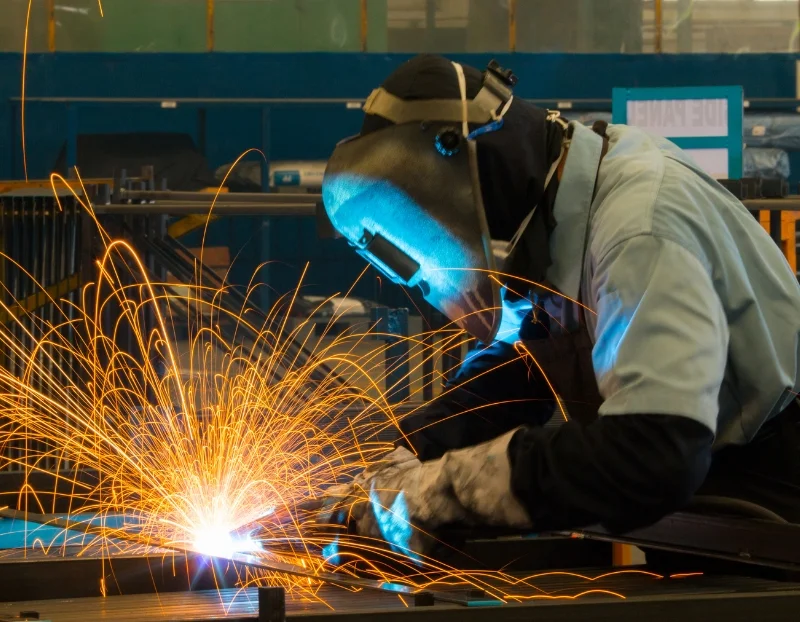
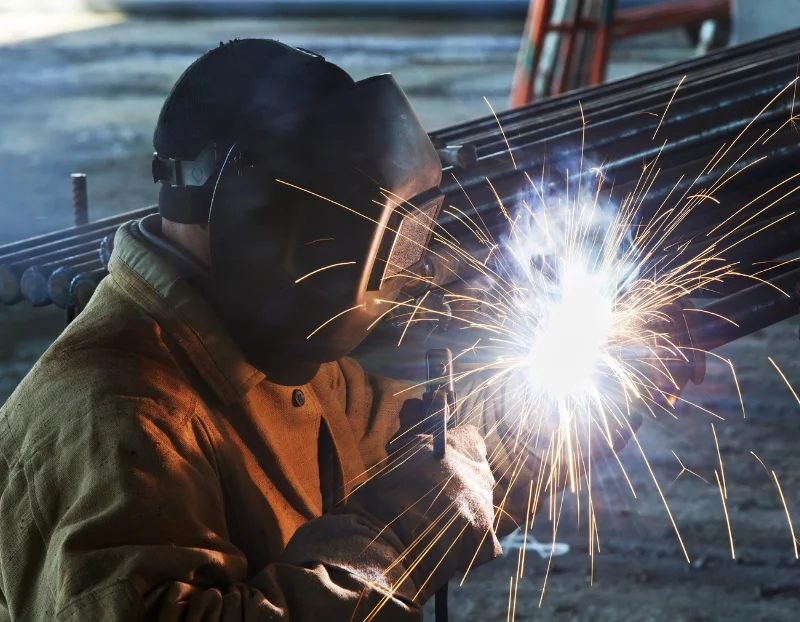
MIG stands for metal inert gas. The formal name is GMAW, gas metal arc welding. A spool of wire feeds continuously through the gun, becomes the electrode and melts into the joint as filler at the same time. A shielding gas flows from the nozzle to keep air off the puddle. For mild steel the usual gas is a 75 percent argon, 25 percent CO2 mix. Straight CO2 is cheaper and penetrates deeper but spatters more.
The welder sets wire speed and voltage, pulls the trigger and moves. Because feeding is automatic, MIG lays down metal several times faster than TIG, and the finished bead needs little cleanup. On thin to medium steel the arc runs in short-circuit mode, where the wire touches the puddle many times a second and the heat stays low enough for 16 gauge sheet. On thicker plate, higher voltage pushes the arc into spray transfer, where a fine stream of droplets gives deep, smooth fusion with almost no spatter.
On site, the same wire feeder can run flux-cored wire instead of solid wire. Self-shielded flux-core needs no gas bottle and ignores wind, which is why it is the field standard for outdoor steel. Gas-shielded dual-shield wire combines flux and gas for heavy, high-strength welds on plate. Partners pick the wire and gas for the job.
- Continuous wire feed, fast deposition, little cleanup
- 75/25 argon-CO2 for clean mild steel welds
- Short-circuit transfer for thin steel, spray for plate
- Flux-core wire replaces gas outdoors in wind
- Spool gun or push-pull gun for aluminum
Common MIG jobs
Steel repairs and fabrication that MIG handles well
If it is steel and it broke, bent or needs building, MIG is usually the right first call.
Gates and fences
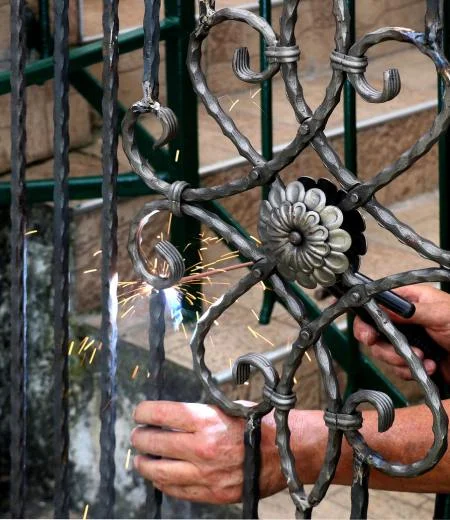
Cracked hinge welds, sagging driveway gates, broken pickets and rusted rail joints. Fast fillet welds on tube and bar, then a coat of primer. See gate welding.
Trailer repair
Cracked tongues, broken crossmembers, fender brackets, ramp hinges and tie-down rings. Fit-up matters here, and some frame repairs call for stick or dual-shield on heavier channel.
Brackets and mounts
Equipment mounts, AC platform brackets, sign posts, bollards and machinery feet. Short welds on 1/8 to 3/8 inch steel are where MIG is fastest.
Racks and shelving
Pallet racking uprights, ladder racks, pipe racks, headache racks and shop shelving built or repaired from square tube and angle.
Stairs and handrails
Loose stringer connections, cracked rail posts and tread brackets on exterior steel stairs. Structural stairs may need engineering review before welding.
General fabrication repair
Broken tables, carts, dumpster lids, loading dock plates, farm gates and bumpers. Covered on our welding and repair page.
What we MIG weld
Mobile MIG welding services for homes, ranches and businesses
Partner welders arrive with the feeder, wire, gas and power to work where the steel already is.
Mild steel fabrication
Square tube frames, angle iron, flat bar, plate and pipe built to your sketch or measured on site. Detailed on mobile steel welding.
Repair of broken welds
Old welds that cracked from fatigue or were never fully fused are ground out and re-welded with proper penetration and a gusset where the design needs one.
Outdoor steel with flux-core
Fence lines, pipe fence, cattle guards, gate posts and yard structures where wind rules out gas. Self-shielded wire gives a sound weld in open air.
Heavy plate with dual-shield
Equipment buckets, trailer frames and skid plates on 3/8 inch and up, run multipass with gas-shielded flux-core for strength and speed.
Aluminum with a spool gun
Light aluminum repairs on toolboxes, ramps and trim using a spool gun with 4043 or 5356 wire and pure argon. Precision aluminum goes to TIG.
Galvanized and coated steel
Coatings are ground back before welding, with ventilation for zinc fumes, then the joint is cold-galvanized or primed so the repair does not become the next rust spot.
Why Alpha Welding
Why customers book MIG work through Alpha
Fast steel repairs by a partner equipped for your site.
Right wire for the weather
Partners carry both solid wire with gas and flux-core, so a breezy site does not mean a bad weld or a second trip.
Self-powered rigs
Engine-driven welder-generators and suitcase feeders on the truck mean no reliance on your outlets for a 200 amp arc.
Honest scope
If a job needs stick, TIG, engineering or a shop, we say so up front rather than forcing MIG onto the wrong work.
Texas-wide partners
Coverage across Houston, DFW, Austin, San Antonio and the regions between, confirmed per address.
How it works
How a mobile MIG job gets done
Four steps from photos to a finished, primed weld.
Send photos
Show the break or the build, the material thickness if known and where the work sits on the property.
Get matched
A partner with the right rig reviews it, we quote and confirm a window, subject to availability.
Prep and weld
Paint and rust ground back, fit-up checked, then welded with the process and wire the job calls for.
Finish
Spatter cleaned, welds inspected, primer or cold galvanizing applied unless you are painting or powder coating.
Technical guide
What customers should know about MIG welding on site
A few points explain most of the decisions a partner makes at your property and most of the problems customers see on bad welds.
Gas MIG versus flux-core in the wind
Shielding gas from a MIG nozzle is blown away by a light breeze, and the weld fills with porosity, the small holes that make a bead look like a sponge. Indoors or behind a windscreen, gas MIG gives the cleanest result. Outdoors, partners switch to self-shielded flux-core wire, usually E71T-11 or E71T-GS, which makes its own protective gas from the flux inside the wire. It runs hotter, spatters more and leaves slag to chip, but the weld is sound in open air. Gas-shielded dual-shield wire, E71T-1 class, is the choice for heavy plate when a windscreen is available.
Short-circuit versus spray transfer
How the metal crosses the arc decides penetration. At lower voltage the wire dips into the puddle and shorts repeatedly, which keeps heat low and suits sheet metal and thin tube. It also risks cold lap on thick steel, where the bead sits on top without fusing. At higher voltage with an argon-rich gas the wire sprays across as fine droplets, giving deep fusion on plate but too much heat for thin material and only in flat or horizontal positions. A partner choosing spray or multipass on your trailer frame is choosing penetration over speed.
Power on site
A proper MIG arc on 1/4 inch steel draws more than a household outlet can supply. Mobile partners run engine-driven welder-generators on the truck, with a suitcase wire feeder that reaches 50 feet or more from the machine, or a standalone generator sized for the welder. Your outlets are rarely needed. If the job is inside a building, in a parking garage or near fuel storage, tell us so the partner plans for exhaust, extension length and fire watch.
When MIG is the wrong tool
MIG wants clean, bright steel. Rust, mill scale, paint, oil and galvanizing cause porosity and weak fusion, so prep is part of every quote. Plate over about 3/8 inch needs beveling and several passes, and stick with 7018 rod often beats MIG on heavy, dirty or rusty sections. Thin aluminum, stainless that will be seen and precision joints belong to TIG. Vehicle frames, pressure parts and structural steel on buildings carry manufacturer, code or engineering requirements that decide the process before the welder does.
Defects you can spot yourself
Porosity shows as pinholes or a pitted bead. Undercut is a groove melted into the base metal at the toe of the weld that was not refilled, and it weakens the joint. Cold lap or lack of fusion looks like a bead lying on top of the metal with a visible edge. Excessive spatter, a tall ropey bead and burn-through on thin material all point to wrong settings. Cracks along the center of a weld usually mean the joint moved while cooling or the wrong filler was used. Any of these on a load-bearing repair is a reason to call before using it.
Finishing and corrosion
A fresh MIG weld on bare steel starts rusting within days in Gulf Coast humidity. Partners wire-brush the weld and apply primer or a zinc-rich cold galvanizing spray unless you plan to paint or powder coat immediately. On galvanized fencing and gates, the zinc burned off during welding must be replaced or the joint will rust first. Tell us if the piece is going to a powder coater so the welds are left clean and unpainted.
What to tell us for a fast MIG quote
- Photos of the break and the whole item
- Steel thickness or tube size if known
- Whether the item is painted, galvanized or rusty
- Indoors, under cover or fully exposed
- Whether it carries load, people or vehicles
Related welding services
Steel job, not sure of the process?
Send photos. We will tell you whether MIG, flux-core, stick or TIG fits, and whether the job can be done on site.
Service area
Where our mobile MIG partners work
MIG-equipped partners are the largest group in our network, so most Texas metros and their suburbs are covered. Coverage and same-day availability are confirmed per address when you request an estimate. Browse every area on the Texas locations page.
Dallas–Fort Worth
Central Texas
South & West Texas
FAQs
Mobile MIG welding questions
Straight answers on process, power and what can be welded at your site.
Is MIG welding strong enough for a trailer or gate?
Yes, when the joint is clean, the settings give full fusion and the thickness is within range. Gates, fences, racks and most trailer repairs are standard MIG work. Heavy trailer frames may get dual-shield or stick and multiple passes for penetration.
Can MIG be done outside in the wind?
Gas-shielded MIG cannot, because the breeze removes the shielding and the weld fills with porosity. Partners switch to self-shielded flux-core wire outdoors, which welds soundly in open air. The bead is rougher and needs slag removal, but strength is not compromised.
Do you need power from my building?
Usually not. Partners run engine-driven welder-generators or portable generators from the truck and reach the work with long leads or a suitcase feeder. If access for a truck is restricted, let us know so the partner can plan cable runs.
Can you MIG weld aluminum?
Light aluminum repairs can be done with a spool gun, pure argon and 4043 or 5356 wire. For thin, cast or visible aluminum, TIG gives better control and a cleaner result. We match the process to the part after seeing photos.
Can you weld rusty or painted steel?
After prep. Rust, paint, mill scale and galvanizing are ground back to bright metal around the joint or the weld will be porous and weak. Heavily pitted steel may need a section replaced rather than welded.
What thickness can mobile MIG handle?
Comfortably from about 16 gauge sheet up to 3/8 inch in a single or double pass. Thicker plate is beveled and welded in multiple passes, often with dual-shield flux-core or stick, which the partner will recommend when it is the better choice.
Will the weld rust?
Bare weld metal rusts fast in Texas humidity, so partners prime or cold-galvanize the repair unless you are painting or powder coating. On galvanized items, replacing the burned-off zinc at the weld is part of the job.
What does a bad MIG weld look like?
Pinholes, a bead sitting on top of the metal with a visible edge, grooves at the weld toe, heavy spatter or burn-through on thin material. If an older repair shows these signs and carries load, have it looked at before relying on it.
Can you weld a vehicle frame or a pressure tank?
Only within manufacturer, DOT and code requirements, which often rule out field repair. Hitch receivers, bumpers and accessory brackets are usually fine. Frame rails, suspension mounts, fuel tanks and pressure vessels need review before anyone welds.
How soon can a MIG partner come out?
MIG-equipped welders are our most common partners, so same-day or next-day visits are often possible, always subject to availability. Call 979-250-7486 or send photos through the estimate form.
Request an estimate
Get fast MIG welding at your property
Send photos of the steel and we will match a mobile MIG partner near you. Call 979-250-7486 or request an estimate online.
- Free, no-obligation estimates
- Photos help us understand the job faster
- Same-day requests depend on partner availability