MOBILE TIG WELDING
Mobile TIG Welding Services
When the weld has to be clean, precise and strong on thin or specialty metal, TIG is the process to ask for. Alpha Mobile Welding TX coordinates TIG-capable partner welders who bring the machine, argon and filler to your site in Texas. Aluminum, stainless, thin steel, cast repairs and visible architectural joints are the everyday work. Send photos and the alloy if you know it. We match the job to the right partner and confirm a visit, subject to availability.
Photos, material type and thickness help us quote TIG work accurately.
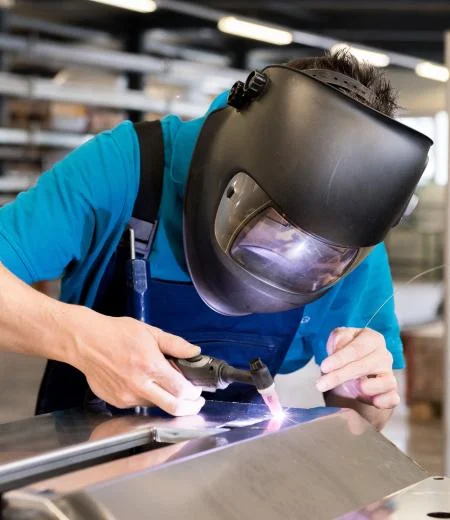
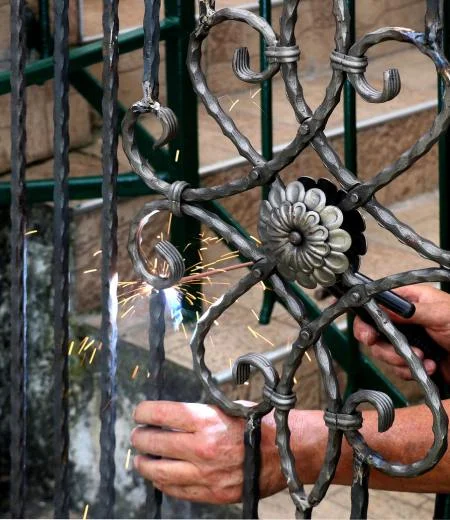
TIG basics
What TIG welding is and why it costs more than other processes
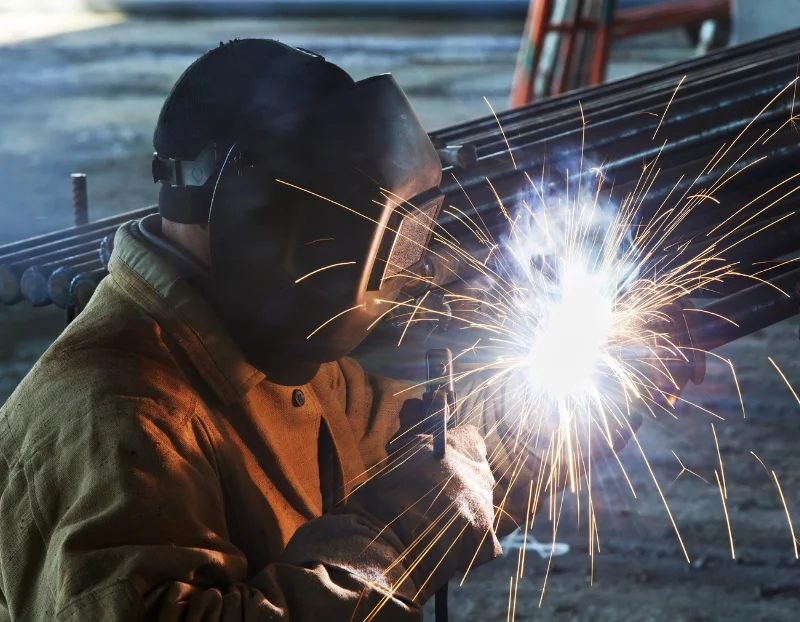
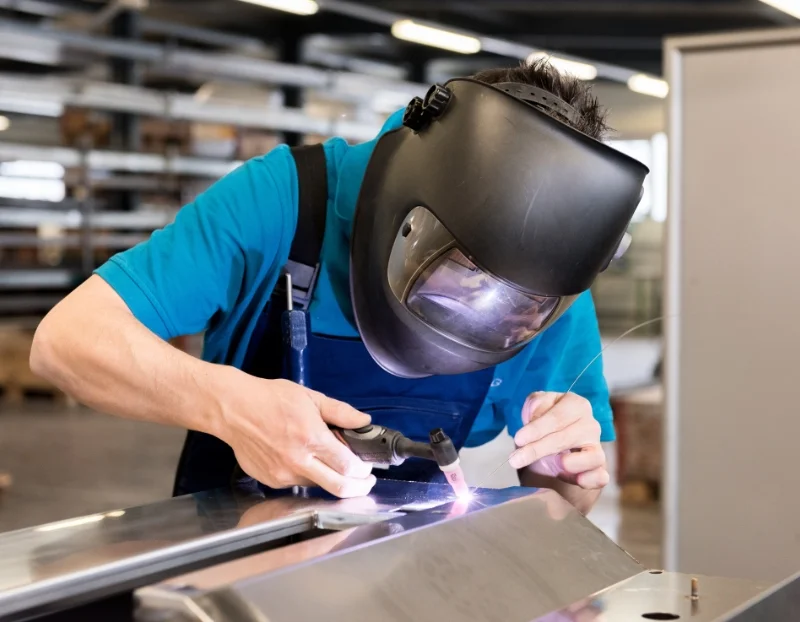
TIG stands for tungsten inert gas. The formal name is GTAW, gas tungsten arc welding. The arc comes off a non-consumable tungsten electrode held in a torch, and argon flows around it to keep air away from the molten puddle. Unlike MIG or stick, the electrode does not melt into the joint. Filler is added separately as a bare rod fed by the welder’s other hand, so the welder decides exactly how much metal goes in and where.
Heat is controlled in real time with a foot pedal or a torch-mounted amperage control. That lets the welder ease into a thin edge, hold a puddle steady and taper off at the end to avoid a crater crack. On steel and stainless the machine runs DC, electrode negative. On aluminum it runs AC, because the alternating current scrubs the tough oxide film off the surface on one half cycle while the other half cycle puts heat into the base metal.
The trade-off is speed. TIG lays down metal slowly and demands a clean joint and a steady hand, which is why it is priced higher per inch than MIG. On the right job that control is the difference between a repair that holds and one that cracks or leaks.
- Non-consumable tungsten electrode, filler added by hand
- Argon shielding protects the puddle from oxygen and nitrogen
- Pedal or torch control adjusts amperage mid-weld
- AC for aluminum and magnesium, DC for steel and stainless
- Minimal spatter, small heat-affected zone, clean bead
Where TIG earns its cost
Jobs that should be TIG welded rather than MIG or stick
If any of these describe your repair, ask for TIG.
Thin sheet and tube
Material under about 1/8 inch burns through fast with hotter processes. TIG lets the partner feather in heat on 16 to 20 gauge sheet, thin-wall tube and formed panels without blowing holes or warping.
Stainless steel
Sinks, prep tables, rails, exhaust and process tube all want TIG. The weld stays bright, heat input is low enough to limit sugaring and carbide precipitation, and the joint can be polished.
Aluminum parts and castings
AC TIG with 4043 or 5356 filler is the standard for aluminum repairs. Cracked intake manifolds, transmission cases, outboard brackets and extruded frames are typical, with preheat on heavy castings.
Visible and architectural work
Handrails, furniture frames, brass and copper trim, signage and anything a customer will look at closely. TIG produces a uniform stacked-dime bead with almost no spatter to grind.
Sanitary and food-grade joints
Dairy, brewery, kitchen and lab fittings need smooth, fully fused, crevice-free welds that can be cleaned. TIG with a back purge on tube is the accepted method.
Motorcycle, auto and boat hardware
Exhaust headers, intercooler piping, aluminum tanks, swingarms, stainless rails and cleats. Small, precise joints on expensive parts.
What we TIG weld
Mobile TIG welding services for homes, shops and businesses
Partner welders bring a TIG rig, argon and the right filler to your site, workshop or yard.
Aluminum repair and fabrication
Cracked boat hulls and tanks, truck toolboxes, trailer ramps, ladder racks and cast parts. AC TIG, correct filler and cleaning before the arc strikes. See our aluminum welding page.
Stainless steel welding
304 and 316 sheet, tube, pipe and plate for kitchens, labs, breweries and rails. Back purging where the inside of the tube matters. Details on stainless welding.
Thin-gauge steel
Sheet metal panels, enclosures, thin tube, brackets and body-style repairs on mild steel where MIG would be too hot and too rough.
Automotive and motorsport parts
Headers, turbo and intercooler pipe, radiators, aluminum oil pans, roll cage tube and custom brackets. Careful fit-up for parts that go back on a running vehicle.
Marine and boat hardware
Aluminum T-tops, leaning posts, cleats, rail stanchions, fuel tank fittings and stainless hardware repaired at the dock or in the driveway, subject to safe access.
Precision and small fabrication
Fixtures, jigs, prototype brackets, small frames and one-off parts that need tight tolerances and a clean bead. Larger structural work moves to MIG or stick.
Why Alpha Welding
Why customers book TIG work through Alpha
One call reaches partner welders who actually run TIG in the field.
Matched to the process
We ask about material, thickness and finish up front, then send a partner equipped with AC/DC TIG, argon and the right filler.
Honest about limits
If a part should go to a shop, needs a purge setup or is not safe to weld, we say so before anyone drives out.
Statewide reach
Partners across Houston, DFW, Austin, San Antonio and beyond, with coverage confirmed per address and date.
Clear pricing
Estimates based on photos and description, with setup, travel and consumables explained before the work starts.
How it works
How a mobile TIG job gets scheduled
Four steps from first message to finished weld.
Send details
Photos, the metal type if known, thickness, where the part is and whether it can be moved under cover.
We match a partner
A TIG-capable welder near you reviews the job and we confirm a window, subject to availability.
Site prep and weld
The partner cleans the joint, sets shielding and amperage, welds and inspects before packing up.
Finish and sign-off
Bead blended or left as welded per your request, with notes on any follow-up such as painting or pressure testing.
Technical guide
What customers should know about TIG welding in the field
TIG is a shop process that can be taken outdoors when conditions are managed. Here is what makes it work on site and what makes it fail.
Wind is the first enemy
Argon flows out of the TIG cup gently, usually 12 to 20 cubic feet per hour. A breeze of a few miles per hour strips that shield off the puddle, leaving a grey, porous weld on steel or a black, sooty bead on aluminum with no strength. Partners carry windscreens and set up inside a garage, shop bay or canopy whenever possible. On a windy open site, a job may switch process or reschedule.
Cleanliness decides the weld
TIG has no flux and a very small puddle, so paint, oil, mill scale, galvanizing and oxide end up as porosity or inclusions. Steel is ground to bright metal. Aluminum is degreased and then brushed with a stainless brush kept only for aluminum, because the oxide layer melts at roughly three times the temperature of the metal beneath it. Cast aluminum often holds oil in its pores and may need a torch pass to cook it out first.
Tungsten types and what they mean
Tungsten electrodes come in alloys identified by a colored tip. Two percent lanthanated (blue) and ceriated (grey) run well on both AC and DC and have become the general-purpose choice. Thoriated (red) was the old standard for DC steel and stainless but is mildly radioactive when ground, so many welders have dropped it. Pure tungsten (green) was traditional for AC aluminum on older transformer machines. On modern inverters the tungsten is ground to a point for both polarities.
Filler rod selection
Filler matches the base metal and the service. For mild steel, ER70S-2 or ER70S-6 is standard. For 304 stainless, ER308L; for 316, ER316L; for joining stainless to carbon steel, ER309L. Aluminum is split between 4043, which flows well and resists cracking on castings and 6061, and 5356, which is stronger and better for 5xxx marine alloys and anodized parts. Rod diameter follows thickness, typically 1/16 inch for thin work and 3/32 or 1/8 for heavier sections.
Back purging on tube and pipe
When a stainless tube is welded through its full wall, the inside surface is also molten and exposed to air. Without protection it forms a rough, oxidized crust called sugaring that traps bacteria in sanitary lines and starts corrosion in process piping. Back purging fills the inside of the tube with argon, sealed with tape, plugs or purge dams, so the root stays bright. It adds setup time and argon cost, and it is the right call for any line that carries product.
Where mobile TIG reaches its limit
TIG is slow. Heavy plate, long fillet welds on gates and trailers, and anything over roughly 3/8 inch is faster and just as strong with MIG or stick, and we will recommend that instead. Field machines run from engine drives or generators, which limits AC output for thick aluminum. Parts soaked with oil or fuel may not be weldable on site. Pressure vessels, fuel tanks and vehicle structural members involve code, manufacturer and safety requirements that may rule out a driveway repair.
What to tell us before we match a TIG partner
- Material: aluminum, stainless, mild steel, chromoly, copper, brass or unknown
- Approximate thickness and the length of weld involved
- Whether the part can go under a roof or into a bay
- Whether the inside of a tube or the finish matters
- Any pressure, fuel, structural or vehicle safety involvement
Related welding services
Not sure if your job needs TIG?
Send photos and a short description. We will tell you whether TIG, MIG or stick is the right process before anyone is dispatched.
Service area
Where our TIG-capable partners work
TIG welders are a smaller group than general mobile welders, so coverage is confirmed per address and date. Partners are concentrated around the major metros and travel to surrounding counties, subject to availability. See the full list on our Texas locations page.
Greater Houston
Dallas–Fort Worth
Central Texas
South & West Texas
FAQs
Mobile TIG welding questions
Straight answers on process, materials and what can be done on site.
What is the difference between TIG and MIG welding?
TIG uses a tungsten electrode that does not melt, with filler rod added by hand and argon shielding. MIG feeds a consumable wire through the gun. TIG is slower, cleaner and more precise for thin, stainless and aluminum work. MIG is faster for thicker steel and long welds.
Can TIG welding be done outdoors?
Yes, with shelter. Argon shielding is easily disturbed by wind, so partners use windscreens, garages, shop bays or canopies. On an open, breezy site the partner may switch to flux-core or stick for steel, or reschedule aluminum and stainless work until the part can be protected.
Can you TIG weld aluminum on site?
Yes. Partners bring AC-capable inverter machines, argon and 4043 or 5356 filler. Cast parts may need preheat and extra cleaning. Thick aluminum sections can exceed what a portable machine delivers, and we tell you that before the visit.
Why is TIG more expensive than MIG?
Deposition is slower, joint prep takes longer, more argon is used and the operator skill level is higher. On jobs that do not need TIG we recommend MIG or stick to save money.
Can a cracked cast aluminum part be repaired?
Often. Intake manifolds, transmission cases, pump housings and outboard brackets are regular TIG repairs. Success depends on the alloy, how much oil has soaked in and whether the crack can be fully ground out. Some castings are too contaminated to take a sound weld.
Do you need to know the exact alloy?
It helps. 6061 aluminum and 304 stainless are common and easy to match. Unknown aluminum usually gets 4043. If a part is stamped or on a drawing, tell us so the partner brings the correct filler.
Will the weld be visible?
TIG produces a neat, even bead with little spatter. For rails, furniture and visible fabrication it can be left as welded or ground and blended. On stainless, blending and passivation help restore corrosion resistance.
Can you TIG weld stainless to carbon steel?
Yes, with ER309L filler, which is designed for dissimilar joints. The weld will not be as corrosion resistant as full stainless, and the carbon steel side still needs coating. This is common on brackets and mounts where only one part is stainless.
Can you repair fuel tanks or pressure parts by TIG?
Only in limited cases. Fuel tanks require thorough purging and are often safer to replace. Pressure vessels, boilers and coded lines fall under inspection and certification rules that a mobile visit may not satisfy. We will tell you honestly if a job belongs elsewhere.
How fast can a TIG partner come out?
Same-day is sometimes possible but always subject to partner availability. TIG-equipped welders are fewer than general mobile welders, so sending photos and material details early gets the right person scheduled sooner. Call 979-250-7486 or use the estimate form.
Request an estimate
Book precision TIG welding at your location
Send photos, material and thickness and we will match a TIG-capable partner near you. Call 979-250-7486 or request an estimate online.
- Free, no-obligation estimates
- Photos help us understand the job faster
- Same-day requests depend on partner availability