The oxide layer: the first thing every aluminum weld has to deal with
Bare aluminum reacts with air within seconds to form a thin, hard, transparent layer of aluminum oxide. That layer is why aluminum resists corrosion so well, and it is also the first obstacle to welding it. Aluminum oxide melts at roughly 3,700°F, while the aluminum underneath melts at about 1,220°F. If the oxide is not removed or broken up, the arc has to blast through a ceramic skin to reach metal that is already liquid beneath it. The result is a weld that looks like it sat on the surface, with oxide folded into the bead and little real fusion.
Welders handle the oxide two ways: mechanically, by cleaning it off immediately before welding, and electrically, by using alternating current on TIG so that the positive half of each cycle lifts the oxide while the negative half puts heat into the metal. Both matter, and the best aluminum welds use both.
The processes: AC TIG and spool-gun or push-pull MIG
AC TIG (GTAW)
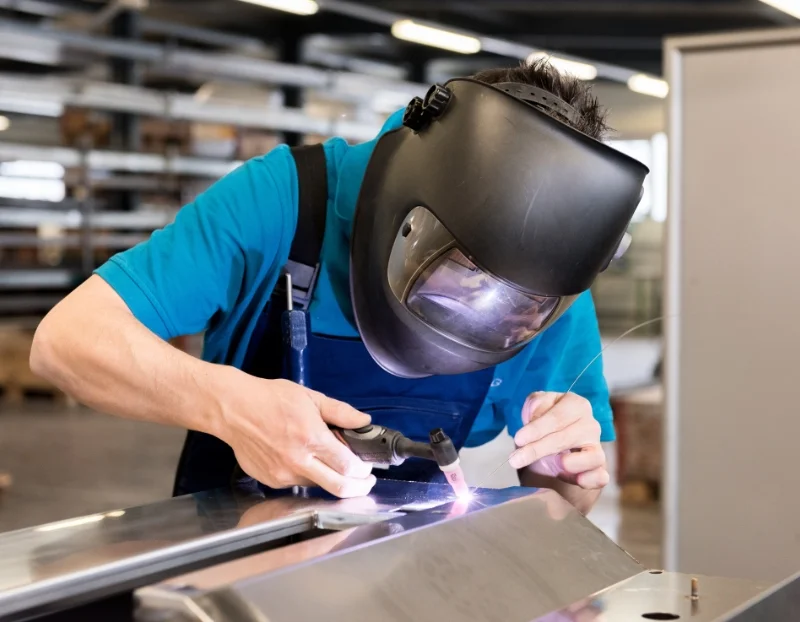
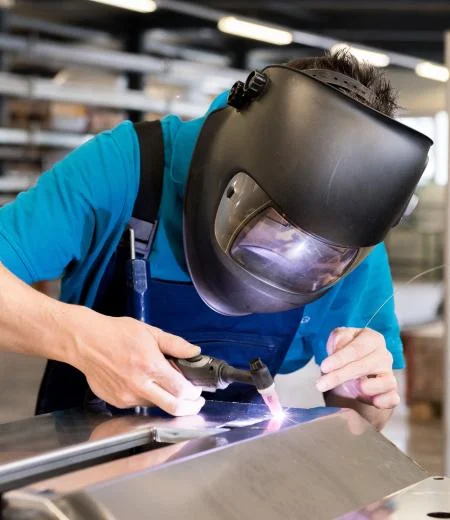
Gas tungsten arc welding with alternating current is the standard for aluminum when appearance, thin material or precision matter. The welder holds a tungsten electrode in one hand and feeds a bare filler rod with the other, under a shield of pure argon. AC balance on modern inverter machines lets the welder set how much of each cycle goes to cleaning versus penetration, and frequency control tightens the arc for narrow fillets. AC TIG is slow and demands a steady hand, but it produces the cleanest, most controllable aluminum weld, which is why it is the go-to for radiator tanks, intake manifolds, thin boat hulls and anything cosmetic.
MIG with a spool gun or push-pull system (GMAW)
Aluminum wire is soft and will bird-nest if it is pushed through a long steel-type liner. A spool gun carries a small spool of wire in the handle so the feed path is only a few inches; a push-pull gun has a second drive motor in the torch that pulls wire from the main feeder. Either way the process is spray-transfer MIG on direct current electrode positive, with argon or an argon-helium mix. Aluminum MIG is much faster than TIG and is the usual choice on trailer frames, ramps, gates and structural extrusions above about 1/8 inch, where speed and heat input matter more than a show-quality bead.
Cleaning: solvent first, then a dedicated stainless brush
Cleaning is not a formality on aluminum; it is where most porosity problems are won or lost. The sequence matters. First, oils, cutting lubricant, fingerprints and road grime are removed with a solvent such as acetone on a clean lint-free cloth. Then the oxide is removed with a stainless steel wire brush that has never touched carbon steel, brushing in one direction so the oxide is lifted rather than smeared back into the surface. Welding should follow within minutes, because the oxide starts re-forming immediately.
Common mistakes include grinding with an aluminum oxide disc that loads up and embeds grit, using a steel brush that leaves iron particles in the surface, brushing before degreasing so the brush drives oil into the metal, and cleaning the whole part in the morning and welding it after lunch. On thick plate, the welder may also chamfer the joint to let the arc reach the root. Hydrocarbons and moisture are the enemy; a damp part on a humid Gulf Coast morning can produce porosity even with perfect technique.
Filler choice: 4043 versus 5356
The two fillers that cover most aluminum work are 4043 and 5356. 4043 is aluminum with about 5 percent silicon. It flows well, wets the base metal nicely, resists hot cracking and gives a smooth bead that is easy to make look good. It is slightly weaker, turns dark gray if the part is later anodized, and is the normal choice for 6xxx-series extrusions and castings. 5356 is aluminum with about 5 percent magnesium. It is stronger and more ductile, stays bright under anodizing, and is preferred on 5xxx-series marine plate, for parts that will see sustained vibration or load, and for anything that needs higher shear strength in the weld. It does not flow as freely and is a little more prone to cracking on 6061 if the joint is highly restrained. Matching filler to base alloy and service is a judgment a competent welder makes before striking an arc.
Heat: conduction, preheat and the narrow working window
Aluminum conducts heat several times faster than steel. On a thin part the whole piece gets hot almost immediately, and the welder has to speed up or the puddle falls through. On a thick part, the opposite problem: the base metal pulls heat away from the joint so fast that the arc cannot establish a puddle, and the result is cold lap with poor fusion at the toes. Preheat solves the thick-section problem. Warming a 3/8-inch plate or a heavy casting to a couple of hundred degrees with a torch lets the arc get ahead of the conduction. Preheat should be moderate and measured with a temperature stick or thermometer; overheating a heat-treated alloy destroys its properties.
There is also no color change to warn the welder. Steel glows red before it melts; aluminum goes from solid to a liquid puddle with almost no visual cue, which is why beginners drop through thin material. Reading the puddle and the shine of the surface is a learned skill, and the window between not-yet-fused and already-burned-through is narrow.
HAZ softening on 6061-T6
Most structural aluminum – trailer tubing, ramps, truck bodies, boat tops – is 6061-T6, which gets its strength from heat treatment. Welding re-heats the metal next to the weld, the heat-affected zone, and partly undoes that treatment. Strength in the HAZ can drop to roughly half of the original T6 value, and it does not come back on its own. The weld itself may be fine; the part fails an inch away from it. Good design and good repair practice account for this by adding gussets, sleeves or doublers so the softened zone is not the only thing carrying load, keeping weld lengths and heat input controlled, and never relying on a single butt weld across a highly stressed tube. Engineered structures may require post-weld heat treatment, which is a shop process, not a field one.
Porosity, cracking and other defects
Porosity is the most common aluminum defect. Molten aluminum dissolves hydrogen readily and rejects it as the metal freezes, leaving gas bubbles in the weld. Hydrogen comes from moisture, oil, hydrated oxide, contaminated filler, a leaking gas line or a drafty work area that disturbs the argon shield. Prevention is cleaning, dry consumables, adequate gas flow and shielding from wind, which is a real consideration for mobile work outdoors.
Hot cracking happens as the weld solidifies, typically down the centerline of the bead or at crater ends. It is driven by alloy chemistry, restraint and crater technique. The fixes are choosing a crack-resistant filler such as 4043 where appropriate, filling craters rather than snapping the arc off, and sequencing welds so the joint can shrink without being locked. Lack of fusion, cold lap and burn-through are the heat-control defects described above. A welder who inspects the back side of the joint, grinds and re-welds suspect areas and does not try to hide a bad start under a second pass is doing it right.
Cast aluminum and dissimilar metals
Cast aluminum parts such as engine brackets, transmission housings, pump bodies and outboard components can be welded, but castings bring their own problems. They are often porous, soaked in oil from years of service, and made of alloys with high silicon content. The usual approach is a thorough bake-out or repeated cleaning to drive out contamination, a pre-weld pass to float out impurities, grinding back to bright metal, preheat, and 4043 filler by TIG. Expect the first pass to look ugly; that is normal. Some castings are simply not economical to repair and should be replaced.
Aluminum cannot be fusion-welded to steel. The two metals form brittle intermetallic compounds the moment they melt together, and the joint will crack. Where aluminum must attach to steel – an aluminum bed on a steel truck frame, for example – the connection is bolted, riveted or made through a bimetallic transition insert. Any welder who offers to weld your aluminum part directly to steel should be politely declined.
Can this be a weekend project?
Aluminum rewards experience and punishes guesswork, and most failed aluminum repairs we see are first attempts on the wrong process with the wrong filler.
Common aluminum parts that get welded in Texas
- Utility and boat trailers: cracked tongue welds, fender brackets, crossmember tubes, bunk mounts and ramp hinges, usually MIG on 6061 tube.
- Boats and pontoons: hull seams, transom reinforcement, cracked ribs and tops, often TIG on 5052 or 5086 plate with 5356 filler.
- Loading ramps and dock plates: fatigue cracks at the hinge and at the curb rails, repaired with gussets rather than a simple re-weld.
- Truck toolboxes, headache racks and flatbeds: split corners, torn mounting feet and new brackets.
- Handrails, gates and ladders: broken pickets, loose posts and rail splices on commercial and residential properties.
- Automotive and equipment castings: intake manifolds, radiator tanks, pump housings and brackets, TIG only.
Safety considerations specific to aluminum
Aluminum welding puts out intense ultraviolet light; the bright surface reflects more of it than steel, so a proper helmet, long sleeves and protection for bystanders matter even more. Fumes from aluminum and especially from magnesium-bearing fillers need ventilation, and any coating, paint or anodizing should be removed from the weld zone. Aluminum does not change color when hot, so burns from handling a part that looks cool are common. On trailers and vehicles, fuel lines, wiring and tires near the weld have to be protected, and the battery disconnected when welding on a wired chassis. Fuel tanks are never welded in the field.
When to call a mobile aluminum welder
If you have a cracked trailer, a torn boat fitting or a broken aluminum part that is hard to move, Alpha Mobile Welding TX coordinates partner welders with AC TIG and spool-gun capability who can come to your property. See our aluminum welding service page for what we handle, our welding and repair page for general repair work, and the mobile welding services overview for how on-site jobs are scheduled. Send a photo of the crack, the approximate thickness and what the part does, and we will tell you honestly whether it is a weld, a weld with reinforcement, or a replacement.
Related services
Need a welder?
Send photos and your location and we will check partner availability and give you an estimate.